
Hantavirus has recently appeared in UK news coverage following reports linked to international travel, prompting understandable concern in workplaces where rodent activity is an issue. For most employers, the key question is not one of alarm, but of proportionate risk management.
From an occupational health perspective, the issue is straightforward: infection is rare in the UK, but the route of exposure is directly relevant to routine workplace activities such as cleaning, maintenance, and facilities management. Employers should also remember that hantavirus is only one example of a workplace biological hazard associated with rodent contamination. Other occupational infection risks, including leptospirosis (Weil’s disease), may also need consideration depending on the work environment and exposure pathway. Understanding how infection occurs and how to manage exposure safely is what enables confident decision-making.
How is hantavirus relevant to the workplace?
Hantavirus is not typically spread from person to person. UKHSA guidance on hantavirus exposure identifies inhalation of airborne particles contaminated with rodent urine, droppings, or nesting materials as the primary transmission route. Exposure concerns are most likely to arise in sectors such as facilities management, housing, waste management, construction, utilities, warehousing, environmental services and maintenance work, where employees may encounter contaminated or infrequently accessed environments as part of routine duties.
This transmission route is directly relevant to routine workplace activity. A facilities operative clearing a storage area, a maintenance worker entering an undisturbed space, or a cleaner dealing with a rodent problem may inadvertently create an inhalation risk if contaminated dust is disturbed during the process. The risk is therefore more about how contaminated environments are handled, which is why cleaning method matters as a practical control measure.
Why does cleaning method matter?
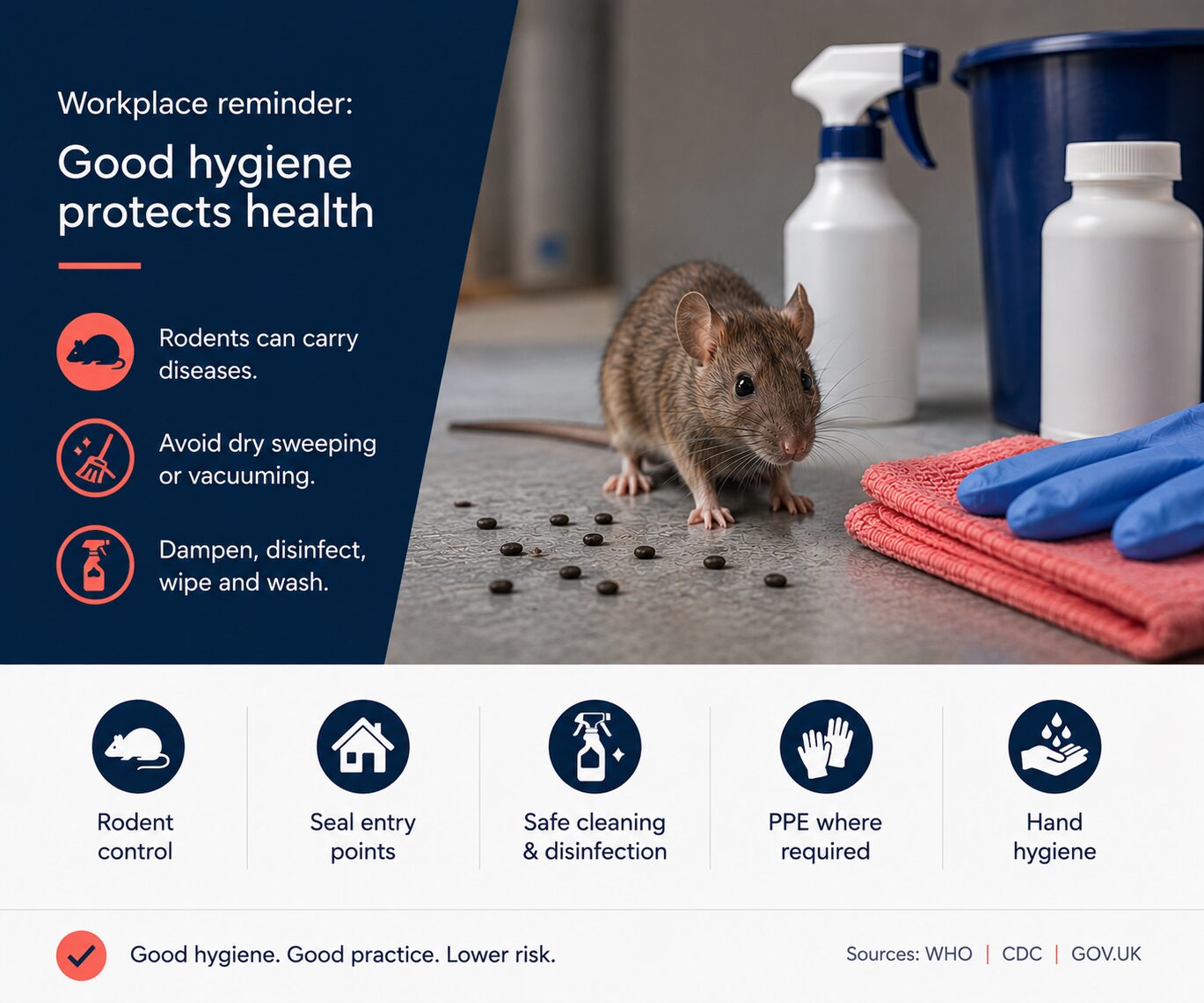
The instinctive response to rodent contamination is often to clean quickly using a brush or vacuum. This approach can significantly increase risk. Dry sweeping or vacuuming can aerosolise contaminated particles, creating the very inhalation hazard that public health guidance seeks to prevent. Under COSHH guidance from the Health and Safety Executive (HSE), employers are required to assess and control exposure to biological agents. Public health guidance supports a wet cleaning approach, which reduces airborne spread and aligns with safer systems of work.
What is the correct cleaning approach?
The safest approach follows a straightforward sequence:
① Ventilate the area before entering and wear disposable gloves throughout
② Apply a suitable disinfectant or diluted bleach solution to droppings and contaminated surfaces and allow adequate contact time in line with the product instructions
③ Wipe up using disposable materials or a damp cloth, seal all waste securely, and wash hands thoroughly afterwards
For most UK workplaces, standard PPE and hygiene precautions are sufficient. Specialist respiratory protection is generally reserved for heavily contaminated or higher-risk environments, identified through risk assessment.
When should employers review their risk controls?
Employers should consider reviewing current procedures when rodent activity is identified on site, when cleaning or maintenance staff are expected to manage contamination, when employees raise concerns about exposure, or when work involves enclosed or infrequently accessed spaces. Relying solely on pest control is not sufficient in these situations. Many organisations have procedures for pest removal but no defined approach to safe post-contamination cleaning and that is where the gap in risk management typically lies.
What are common mistakes in the workplace?
In practice, exposure concerns are often made worse not by the presence of rodent contamination itself, but by inconsistent or poorly communicated responses.
Common mistakes include:
Most of these risks are preventable with clear procedures, appropriate communication and proportionate occupational health input where needed.
When is an occupational health referral appropriate?
An occupational health advice or referral is appropriate where there is uncertainty about exposure risk or employee fitness for work following potential contact with rodent contamination. This includes employees who may have been exposed during inappropriate clean-up, individuals reporting symptoms after suspected exposure, and vulnerable workers with underlying medical conditions who have been involved in clean-up tasks.
Early referral allows for a clinical risk assessment based on the actual work activity, rather than relying on assumptions or general guidance applied without context.
What does occupational health input provide?
A physician-led occupational health service provides structured, evidence-based input that goes beyond general guidance. This includes assessment of exposure risk based on the specific work activity, advice on fitness for work and any necessary restrictions, recommendations on workplace adjustments or controls, and clear communication for both employer and employee where risk is low. The outcome is clinical reassurance, as well as documented, defensible decision-making that supports both the organisation and the individual. This is particularly important where employers are managing safety-critical work, vulnerable employees, or operational pressures alongside employee wellbeing concerns.
What are the risks of getting this wrong?
While hantavirus infection is uncommon in the UK, poor management of contamination risks can lead to avoidable employee exposure concerns, increased sickness absence driven by uncertainty rather than clinical need, inconsistent cleaning practices across sites, and lack of legal defensibility if procedures are later challenged. Clear processes and early occupational health input address all of these.
What should managers do now?
Managers do not need to become infection control specialists, but they do need to ensure that cleaning methods align with public health guidance, that staff are not using high-risk approaches such as dry sweeping, and that exposure concerns are assessed appropriately rather than dismissed. The practical question is simple: do your current procedures reduce airborne risk or inadvertently increase it?
Hantavirus is a useful reminder that workplace health risks are often connected to everyday tasks performed without adequate controls. The difference between safe and unsafe practice in this case is not complicated but it does need to be defined, communicated, and followed. Where uncertainty exists, early occupational health involvement provides clarity and clinical grounding.
If you need advice on exposure risk, workplace cleaning procedures, or employee fitness for work, speak to our team at Workforce Wellbeing.
——————————————————————————————————————-
Last reviewed: 8 May 2026
Reviewed by Dr Massoud Mansouri, Consultant Specialist in Occupational Medicine.


