
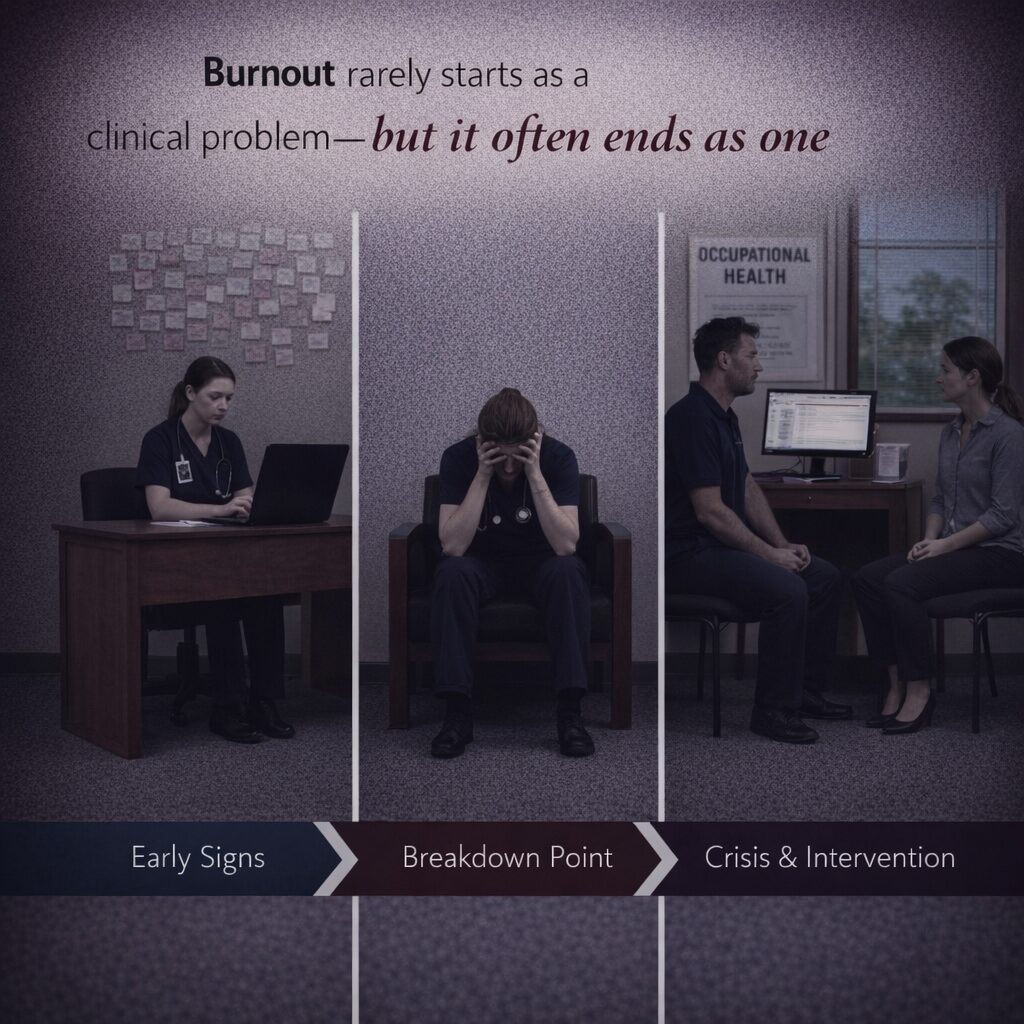
Across the UK, many employees are referred to occupational health only after burnout has fully taken hold. By the time an occupational health referral is made, the situation is rarely straightforward or confined to the individual. More often, it reflects a pattern of work that has become unsustainable long before anyone pauses to intervene.
In practice, people are usually seen after workplace adjustments have already failed and personal coping strategies have been exhausted. Unfortunately, the referral often arrives at the point of collapse.
In most cases, earlier than they do!
By the time occupational health becomes involved, the pace of work has not changed and the demands have not eased. Instead, individuals have adapted, carrying more responsibility, more urgency, and more emotional load.
By this stage, many already feel they have failed. Anxiety is common. Shame is common. Discomfort about being referred is common. This matters, because it shapes how people engage with support and how quickly they recover.
From an occupational health perspective, burnout is not a failure of resilience. It is a predictable human response when demands consistently exceed what a person can reasonably sustain.
A key part of the consultation is reassurance. Feeling overwhelmed, anxious, low in mood, or developing physical symptoms is not personal weakness. It reflects prolonged imbalance between workload, control, recovery, and support.
When you look back, the pattern is usually visible well before sickness absence begins. Work does not really stop. Priorities keep shifting. There is constant switching and reactive communication. Capable people quietly absorb more and more, until absorbing becomes the expectation. Over time, asking for support starts to feel like failure.
Occupational health does not simply label someone as “burnt out”. Our physician‑led assessment uses a biopsychosocial approach to understand how work design, health, and individual circumstances interact.
The focus is on fitness for work. That means considering what aspects of the role are currently unsustainable and what adjustments are clinically reasonable. Clear, practical recommendations allow managers to move away from vague wellbeing conversations and towards confident, defensible decisions that support both the individual’s recovery and the organisation.
When referral is delayed, the individual often becomes framed as the problem. Performance drops, absence increases and more importantly emotions escalate.
At that point, recovery usually takes longer. Confidence is lower. Trust in the organisation may already be damaged. What could have been a period of adjustment becomes a prolonged sickness absence issue.
Early occupational health referral can prevent this escalation. It allows issues to be addressed while the employee still has capacity, engagement, and a sense of agency.
Managers should act when they see changes in behaviour, not just reduced performance. Work‑related stress often appears as someone behaving out of character rather than openly saying they are struggling.
Early signs may include starting work earlier, finishing later, or working irregular hours in an effort to keep up. Managers may notice increased reactivity, reduced organisation, difficulty concentrating, or unusual anxiety about mistakes. Communication often shifts for example shorter or more abrupt emails, withdrawal from discussions, defensiveness, or visible frustration where it was not present before.
Persistent fatigue, irritability, and reluctance to take time off are also important signals. These behaviours are frequently misread as commitment. Clinically, they are often early indicators that work demands are exceeding capacity.
These signs should prompt a supportive conversation and consideration of early occupational health referral. Acting early allows adjustments to be made while the employee still has capacity, reducing the risk of sickness absence and prolonged recovery.
Workforce Wellbeing provides training sessions for managers on recognising early signs of stress, having appropriate conversations, and knowing when to involve occupational health. This helps managers act earlier and make confident, defensible fitness for work decisions.
If you need advice on burnout, fitness for work, or whether an occupational health referral would be appropriate, you can use the referral button on our website to make a referral or contact us for advice. Early referral can prevent escalation and support better outcomes for both employees and organisations.


