
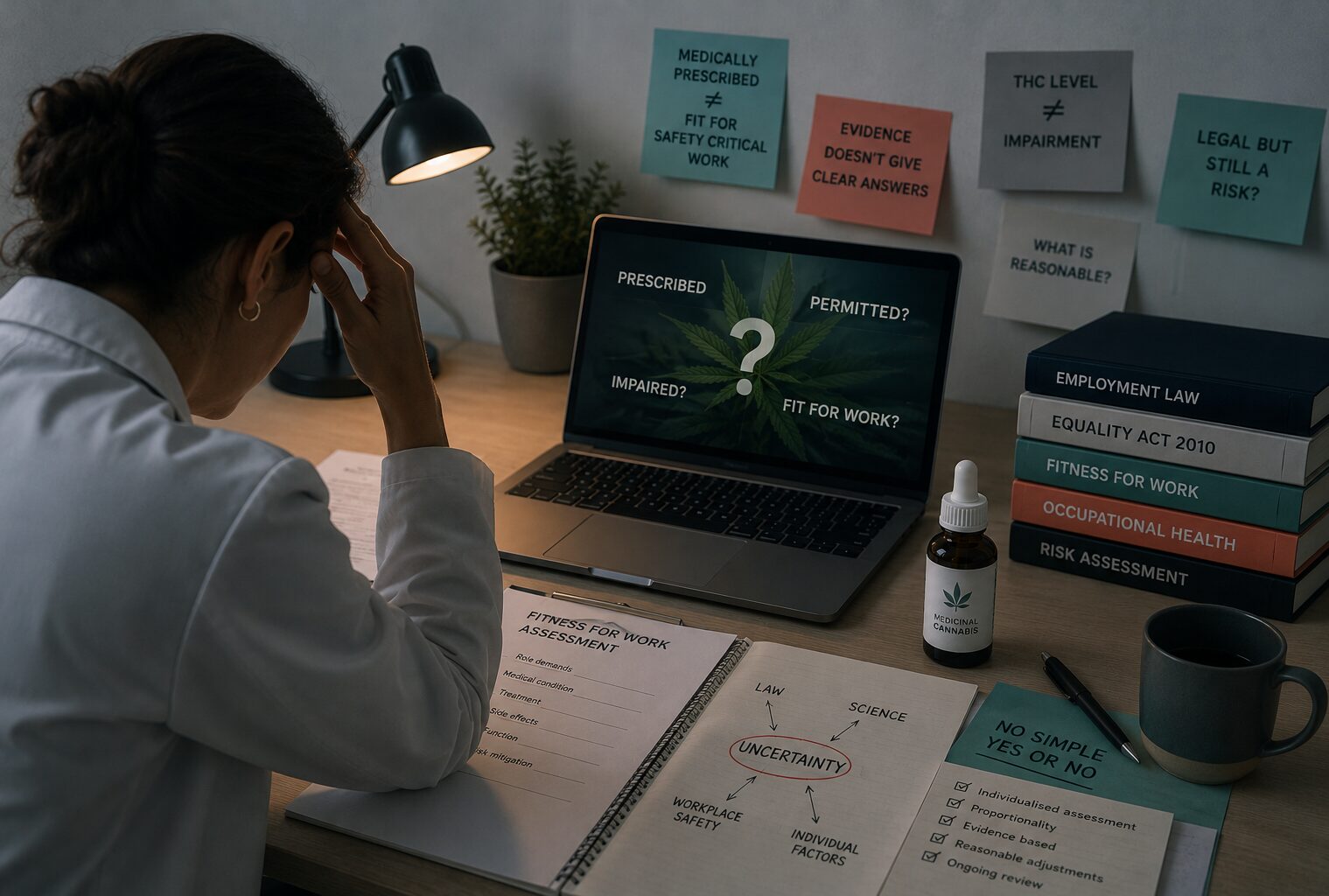
A practical, evidence-informed guide to navigating one of the most complex areas in UK workplace health.
More employees across the UK are being prescribed medicinal cannabis and most employers, HR teams, and health and safety experts are navigating this without clear guidance. The legal framework is developing. The science is more complex than most workplace policies acknowledge. The consequences of getting it wrong can be serious for everyone involved.
This guide sets out what the evidence actually tells us, what the law currently requires, and how a defensible, fair approach to fitness for work can be achieved in practice.
A growing body of peer-reviewed research including studies published in Forensic Science International and Clinical Chemistry, as well as randomised clinical trials and systematic reviews, consistently shows that THC blood concentration does not reliably predict functional impairment. Researchers have found no statistically significant correlation between THC levels measured in blood, oral fluid, or breath and objective measures of driving performance or cognitive function.
The biological reasons for this are well established:
THC is highly lipophilic. It is stored in fatty tissue and released slowly, meaning it can be detected in the body long after any acute impairment has resolved. A regular cannabis user may record THC levels above the UK’s legal drug-driving threshold of 2 micrograms per litre of blood without experiencing any clinically meaningful functional deficit. Conversely, another individual may be impaired at a level below that same threshold.
It is also important to understand what the UK drug-driving threshold was designed for. It was developed as a legal enforcement tool for road safety purposes.
There is also an important and counterintuitive finding in the clinical literature: in cases where medicinal cannabis effectively manages a condition that itself impairs function, the net functional effect may be neutral or even favourable compared to leaving that condition untreated. This does not remove the need for careful assessment, though.
The practical implication is this: biological test results should inform occupational health assessment, not replace it.
The legal framework around medicinal cannabis and workplace safety is actively developing through case law, and recent decisions have significant implications for how employers manage these situations.
In Truman v SPL Powerlines UK Ltd and others, a case arising from Network Rail’s drug and alcohol regime, the Employment Appeal Tribunal found that the original tribunal had failed to properly consider whether blanket application of a positive test policy constituted disability discrimination under the Equality Act 2010. Expert evidence was accepted that the claimant (a worker prescribed medicinal cannabis for chronic pain) could potentially have carried out his role safely with appropriate safeguards in place. The EAT’s decision is a clear signal. A positive test is not the end of the analysis. Employers who apply blanket policies without individual assessment are exposed to discrimination claims, particularly where the underlying condition may qualify as a disability under the Equality Act.
A proportionate, documented, case-by-case approach is good practice.
For occupational health purposes, the source and nature of a prescription matters considerably.
There is a meaningful clinical and governance distinction between cannabis prescribed within NICE-supported indications, such as certain forms of treatment-resistant epilepsy, chemotherapy-induced nausea, or spasticity in multiple sclerosis, under specialist oversight, and cannabis-based products issued via private clinics, where prescribing rationale, THC concentration, formulation, monitoring arrangements, and clinical governance may vary considerably.
Neither category is the same as recreational cannabis use, which remains a Class B offence and involves no medical oversight, no consistent dosing, and no accountability for product composition.
Conflating these three is both a clinical and a legal error. An employer treating a specialist-prescribed medication as equivalent to recreational drug misuse is likely to face significant difficulties if challenged under the Equality Act or in employment tribunal proceedings.
A prescription alone does not automatically mean someone is fit for all duties. Equally, a prescription should not automatically lead to a restriction or an adverse outcome. The assessment needs to be individualised, role-specific, and grounded in functional evidence rather than biological markers alone.
In practice, a well-structured occupational health fitness for work assessment in these cases should address:
The role and its actual safety-critical demands. There is a significant difference between a desk-based administrative role and one involving driving, railway infrastructure, machinery operation, work at height, or responsibility for vulnerable individuals. The level of scrutiny should be proportionate to the actual risk.
Evidence of functional impairment. The question the assessment is trying to answer is whether this individual, in this role, with this pattern of use and this underlying condition, presents a risk that cannot be adequately managed. That cannot be answered by a test result alone.
Clinically relevant side effects. THC can affect concentration, reaction time, judgement, situational awareness, and cognitive processing. Whether these effects are present, to what degree, and in what circumstances is a clinical question that requires individual assessment.
Reported pattern of use. Timing and frequency of use are relevant factors, but they must be interpreted carefully. The research evidence is consistent on this point: impairment does not follow a predictable time course and cannot be reliably inferred from reported dose or timing alone. This information should form part of the broader clinical picture, not serve as a standalone safety proxy.
Whether reasonable adjustments or safeguards are feasible. In some cases, temporary duty modifications, enhanced supervision, or adjusted working arrangements may allow an individual to continue working safely while a clearer picture is established. Employers are generally required to consider this before dismissal or withdrawing job offers.
Occupational health does not replace the employer’s responsibility to carry out workplace risk assessments. What it provides is individualised, evidence-informed clinical advice that helps employers make balanced, proportionate, and legally defensible decisions.
The most effective approach and the one most likely to withstand legal scrutiny combines an individual occupational health fitness for work assessment with an employer-led workplace risk assessment that considers the specific demands and hazards of the role in question.
Occupational health advice in these cases typically considers the employee’s functional capacity, the safety-critical demands of the role, the nature and governance of the prescription, reported side effects, the underlying health condition and its own functional impact, and potential workplace adjustments or temporary controls.
This approach moves organisations away from assumptions and blanket policies and towards the kind of evidence-informed, proportionate decision-making that protects employees, employers, and often the wider public. The Society of Occupational Medicine (SOM) has also highlighted the increasing complexity surrounding medicinal cannabis, workplace testing and safety-critical work.
Medicinal cannabis prescribing in the UK has increased substantially since specialist prescribing became legal in 2018. As the number of prescribed patients grows and as awareness of legal rights increases workplace cases involving THC, fitness for work, and safety-critical duties are appearing more frequently across a wide range of sectors, from transport and utilities to healthcare and emergency services.
Organisations that have not reviewed their drug and alcohol policies, or that continue to apply binary test-based approaches without individual assessment, are increasingly exposed both legally and reputationally.
Can someone work while prescribed medicinal cannabis? Often yes, but it depends on the specific role, its safety-critical demands, the functional impact of the medication and the underlying condition, and whether appropriate safeguards can be put in place. A blanket answer in either direction is rarely appropriate or defensible.
Does a positive THC test automatically mean someone is unfit for work? No. Peer-reviewed research consistently shows that THC blood levels do not reliably correlate with functional impairment. Occupational health assessments should consider the full clinical and functional picture, not rely on toxicology results alone.
Can employers restrict duties or withdraw a job offer? Employers may need to consider restrictions or adjustments where there are legitimate, evidenced safety concerns but this must be proportionate, individually assessed, and take reasonable adjustments into account. Blanket policies applied without individual assessment carry significant legal risk under the Equality Act 2010.
Who is responsible for the workplace risk assessment? The employer retains responsibility for workplace risk assessment. Occupational health provides individualised clinical advice to inform that process. The Health and Safety Executive (HSE) provides guidance on managing drug and alcohol-related risks at work.
Is privately prescribed medicinal cannabis the same as NHS or specialist-prescribed cannabis? Not necessarily. Prescribing rationale, clinical governance, and monitoring standards may vary considerably between private clinics. This is clinically relevant and should form part of the occupational health assessment.
We support organisations with fitness for work assessments, safety-critical role evaluations, and occupational health advice on cases involving medicinal cannabis. Our approach is evidence-informed, proportionate, and focused on practical outcomes that protect both workplace safety and individual rights.
If you are dealing with a case like this, or want to review your drug and alcohol policy in light of the developing legal and clinical landscape, we would be glad to help.
——————————————————————————————————————–
Last reviewed: 18 May 2026
Reviewed by Dr Massoud Mansouri, Consultant Specialist in Occupational Medicine. His work includes fitness-for-work assessments, safety-critical occupational health and complex workplace health cases.


