
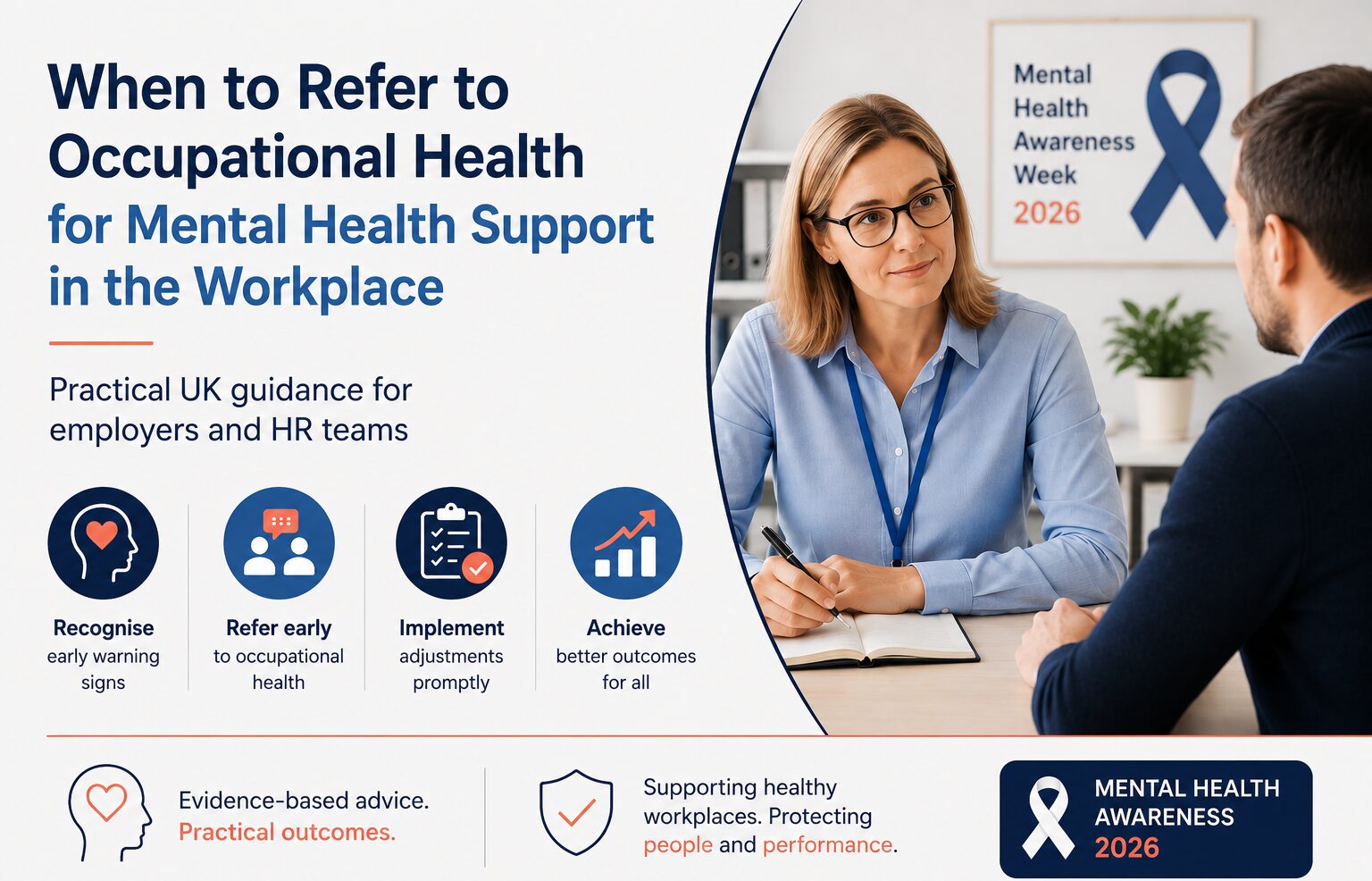
Mental Health Awareness Week 2026 (11-17 May) highlights an essential message: awareness must translate into action.
For UK employers, the priority is clear: spot difficulties early, take them seriously, and refer to occupational health before things deteriorate. This approach ensures employees receive effective, evidence-based support whilst enabling managers to make clear, confident, and clinically informed decisions that protect both employee wellbeing and organisational interests.
A mental health occupational health assessment evaluates how psychological health affects an individual’s ability to work. Unlike clinical psychiatric assessment, the focus is on functional work capacity, not diagnosis alone. The occupational health physician or nurse will explore:
The assessment typically lasts 30-45 minutes and takes place face-to-face, via secure video consultation or phone.
The occupational health report provides practical, actionable guidance:
This structured approach ensures consistency and fairness, particularly important during Mental Health Awareness Week when increased employee disclosures require clear, evidence-based responses. Please see at the bottom for the links to related resources.
Delayed occupational health referral leads to prolonged absence, increased costs, and poorer employee outcomes.
The evidence on this is consistent: the longer someone is absent, the harder return becomes. Psychologically and practically. Waiting for a crisis to develop before referring to occupational health makes the situation harder to resolve.
Early occupational health involvement often changes the trajectory of a case. When referral happens promptly, the factors most likely to entrench absence (uncertainty, loss of workplace connection, untreated anxiety about return) can be identified and addressed while they’re still malleable. Adjustment recommendations carry clinical weight rather than reflecting what seemed reasonable under pressure. The employees who maintain even a structured, light-touch connection to their workplace during absence consistently show better return-to-work outcomes than those who don’t.
The cumulative effect is a shift from reactive to rehabilitative and from managing the fallout of absence to reducing how much absence there is to manage.
This is reflected in where UK practice has moved. In the NHS, local government, education and emergency services and other sectors, where mental health-related absence runs at volume and the operational consequences are acute, early intervention occupational health has become the expected standard. The evidence base drove that shift. So did the cost of not changing.
A high-quality occupational health report provides clear answers to the questions employers need resolved. A quality report resolves the questions managers actually need answered. It defines clearly what the employee can and cannot do. Recommendations are specific and implementable, not generic. Timescales are realistic, with review points built in and the advice should hold up to employment tribunal scrutiny. Tat’s the standard worth holding your occupational health provider to.
For managers, the difference is felt quickly. Decisions that once felt uncertain have clinical grounding behind them. Absences resolve faster. Employees supported through a proper return-to-work process are more likely to come back and remain in work, and the legal exposure that poorly managed mental health cases carry (discrimination claims, unfair dismissal challenges) reduces significantly. The goal is safe, sustainable return to work that benefits both individual and organisation.
Can we refer before the employee is absent?
Yes. Occupational health referral is appropriate when an employee is struggling at work, even if they have not yet been absent. Early assessment can identify necessary adjustments, prevent absence, and support the employee to continue working effectively. Presenteeism (being at work whilst unwell) often causes more harm than timely intervention.
No. Referral is based on functional impact on work, not confirmed psychiatric diagnosis. You refer because performance, attendance, or behaviour has changed, or because the employee has disclosed difficulties. The occupational health professional will assess work capacity regardless of whether the employee has been formally diagnosed.
Most employees engage positively when the purpose is explained clearly: the assessment is about support and workplace adjustments, not judgement or blame. Emphasise that:
If an employee refuses, you can explain that management decisions may need to be made without clinical input. Please see the links below for additional related resources.
No. Occupational health provides clinical expertise to inform management decisions. It does not make employment decisions. Line managers remain responsible for absence management, performance management, and implementing workplace adjustments. Occupational health strengthens this process by providing evidence-based guidance on what is medically appropriate and legally defensible.
Costs vary depending on complexity and urgency. Contact us for a tailored quote. Many employers find that the cost of occupational health input is significantly lower than the cost of prolonged absence, tribunal claims, or premature workforce exit.
If you need professional guidance on managing mental health in the workplace, Workforce Wellbeing provides specialist occupational health services across the UK.
Our FFOM-led team includes psychiatrists, occupational health physicians and nurses with mental health expertise, access to consultant psychiatrist input, and experience supporting organisations with stress-related absence, burnout, and neurodiversity workplace assessments.
If you need advice on managing mental health in the workplace, you can arrange an occupational health referral or consultation with Workforce Wellbeing


